
Search Lafayette County Bankruptcy Records
Lafayette County bankruptcy records sit at the point where county court access and federal bankruptcy access meet. The county clerk helps with local court records, judgments, liens, and forms, while the Western District of Wisconsin controls the actual bankruptcy file. That split matters because the same name can appear in more than one place. It also means a fast search may start with WCCA or the clerk office, then move to PACER or the federal clerk when you need the docket, the discharge, or a certified copy. The right office saves time and keeps the search from going in circles.
Lafayette County Bankruptcy Records Overview
Lafayette County Bankruptcy Records at the Clerk
The Lafayette County Clerk of Courts is the first local stop for many record questions. The office handles court forms, court records for civil, criminal, family, traffic, and ordinance cases, the civil judgment and lien docket, online fee payments, and jury information. The office is at 626 Main St, Darlington, WI 53530, and the contact name in the directory is Trisha Rowe at (608) 776-4832. For passport questions, the office also takes calls weekdays from 9:00 a.m. to 4:00 p.m. That mix of record work and public service makes the clerk a practical entry point when a bankruptcy issue also touches county filings.
The Lafayette County legal resources page adds more local contact points. The Circuit Court can be reached at (608) 776-4811. The Family Court Commissioner is at (608) 523-4244. Victim/Witness assistance is at (608) 776-4846. Legal Action of Wisconsin is available at (855) 947-2529 for low-income civil legal services, and Free Legal Answers Wisconsin is available for online questions answered by volunteer attorneys. Those offices do not hold bankruptcy files, but they help people sort out the court and debt pieces that often follow a bankruptcy filing.
The county clerk page at Lafayette County Clerk of Courts is the source for the image below. It shows the office that manages the local record side of the search.
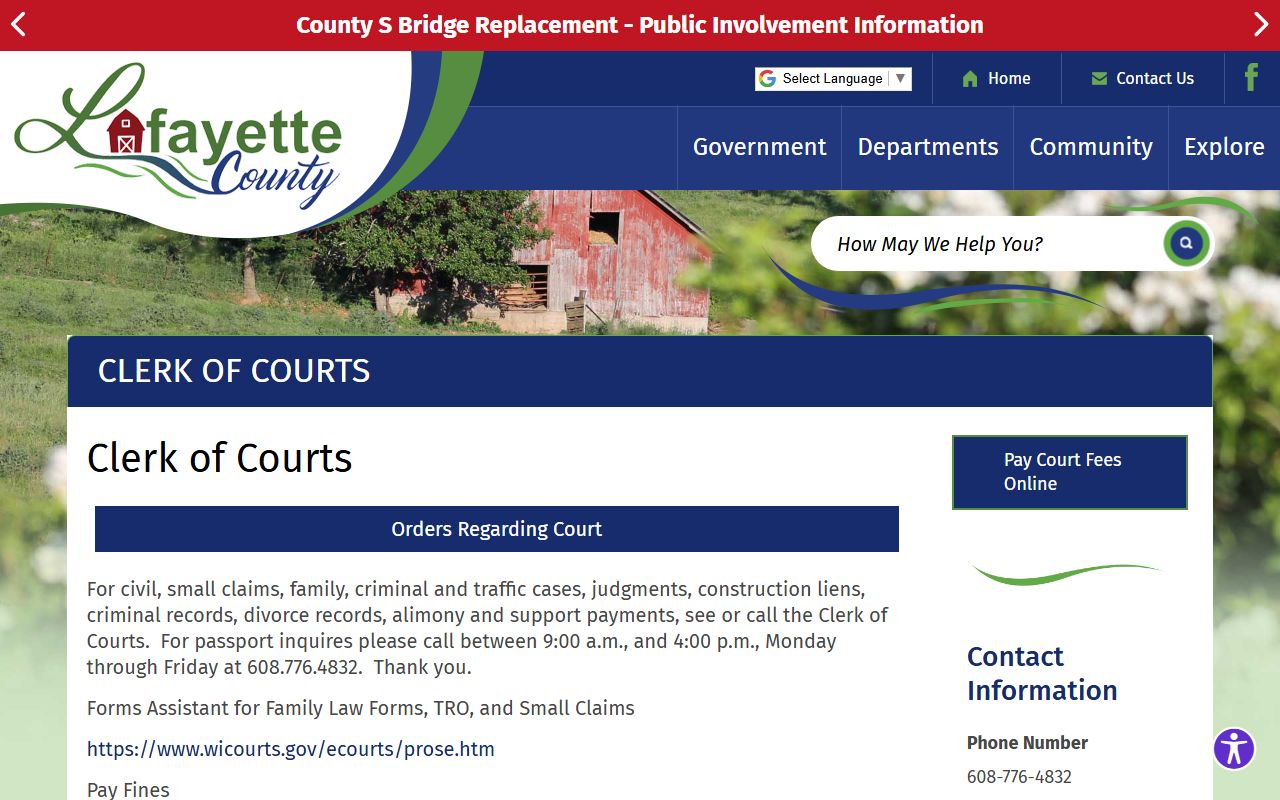
That office is the right place to confirm whether a local paper file, judgment, or lien docket belongs in the search trail.
The same county page also points to the forms assistant for family law, TRO, and small claims forms, and it links online fee payment through the Wisconsin Circuit Court Access payment page. Those tools are useful when a local filing sits next to a bankruptcy issue and you need the county side of the record first.
The county page at Lafayette County Clerk of Courts is also the source for the second image below, which shows the local court office that handles record requests and public service questions.
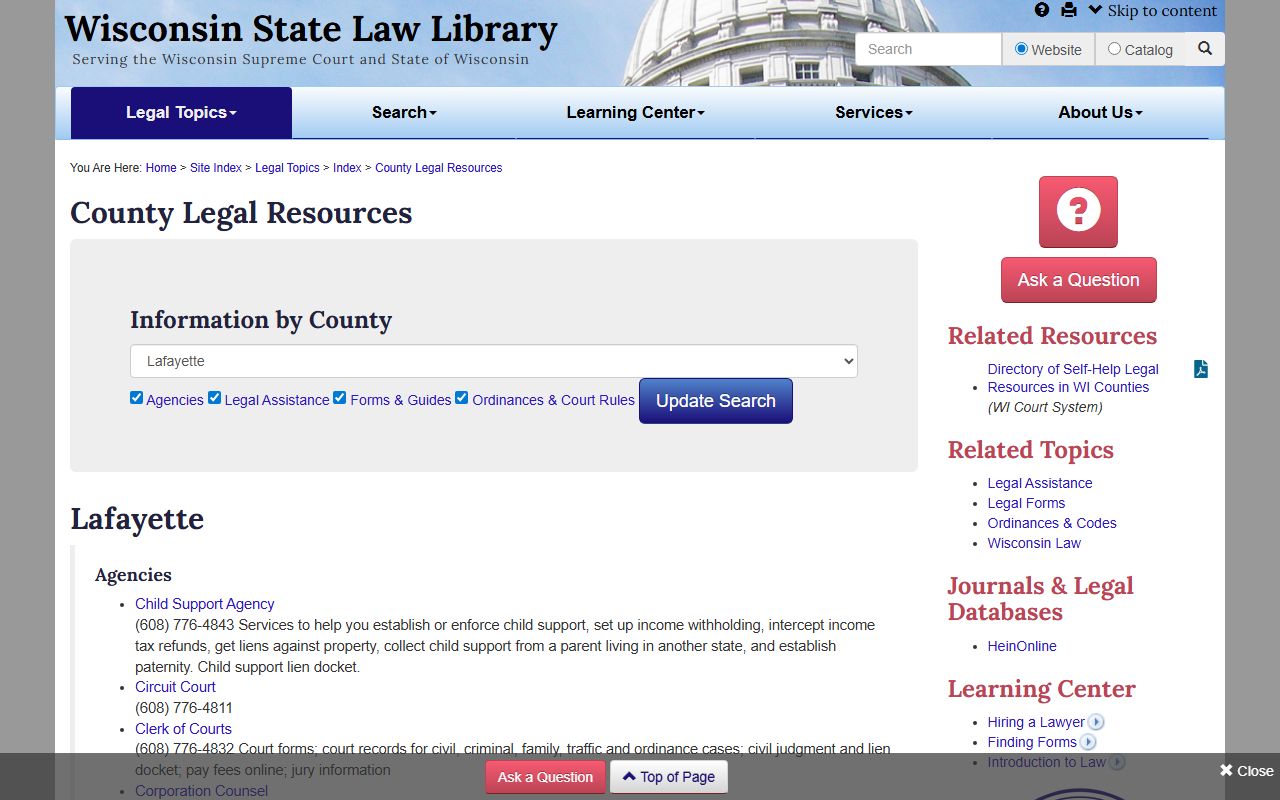
That image keeps the Lafayette County bankruptcy records search tied to the courthouse office rather than a third-party source.
How to Find Lafayette County Bankruptcy Records
WCCA is the main public entry point for Lafayette County circuit court records. The system lets you search by party name, business name, or case number, and it provides case summaries instead of full-text documents. That makes it useful when you need to see whether a county case exists, when it started, or whether a related lien or judgment was entered. It is also a good way to confirm whether the matter is civil, family, criminal, traffic, or small claims before you ask the clerk for a paper copy. Use WCCA for that first pass.
The limits matter just as much as the search field. WCCA does not display confidential matters, and actual documents are not available online. If you need filings or copies, you must go to the Lafayette County Clerk of Courts office at 626 Main St, Darlington, WI 53530. Standard copies cost $1.25 per page, and certified copies cost $5 per document. That is the practical boundary between a public docket summary and a usable certified record. It also helps avoid the common mistake of expecting the portal to deliver a full case file.
The Wisconsin State Law Library bankruptcy page is a useful companion source because it brings together Bankruptcy Basics, PACER, the bankruptcy courts, and Wisconsin forms in one place. For Lafayette County, that keeps the search in official sources and avoids low-quality shortcuts. If you are trying to understand where a file went or how a record fits into the larger court system, that page gives you a clean map.
For a more direct county search, the clerk directory entry for Lafayette County lists Trisha Rowe at 626 Main St, Darlington, WI 53530-1396, with the same main phone number. The Wisconsin Court System directory is useful because it confirms the official recordkeeping office. That matters when a paper request, a mailed copy request, or an in-person visit needs to go to the correct desk the first time.
Use WCCA for the public summary, the clerk office for the actual paper, and the state law library for the supporting forms and help links. That is the clearest path when Lafayette County Bankruptcy Records are only one part of the paper trail.
Lafayette County Bankruptcy Records in Federal Court
Lafayette County is in the Western District of Wisconsin U.S. Bankruptcy Court. That is the court that actually holds the bankruptcy file. The court says basic case information is available free through McVCIS at (866) 222-8029, and the line works 24 hours a day, seven days a week. McVCIS can give you the case number, debtor name, filing date, attorney contact, assigned judge, trustee, case status, 341 meeting date, asset status, claim deadline, discharge date, closing date, and case disposition. When you want a quick answer, that is often the fastest starting point.
For in-person review, the Western District lists two courthouse locations: the Madison Courthouse at 120 North Henry Street, Room 340, Madison, WI 53703, and the Eau Claire Courthouse at 500 South Barstow Street, Room 223, Eau Claire, WI 54701. Office hours are Monday through Friday from 8:00 a.m. to 4:30 p.m. The research also notes that PACER contains bankruptcy information from cases filed on or after April 1, 1991, and document copies are available for cases filed on or after February 1, 2002. That date line matters when a Lafayette County case is old enough to sit on the edge of electronic access.
If you need a certified copy, the court requires a written request and fees for the search, certification, and photocopies. Payment must be made by cashier's check or money order. Debtors can get a free copy of their discharge if the discharge happened after February 2002, and the request can be made by phone, mail, or in person. That is a useful cost break when the only thing needed is proof of discharge rather than the whole file. The court also says tax returns should go to the trustee, not the court, unless the judge says otherwise. That detail is easy to miss and can save a misdirected mailing.
Lafayette County debtors using eSR can prepare the petition online, but the original signature forms must be mailed within 14 days of electronic submission. That rule keeps the electronic filing process tied to the paper signature trail. It also matters for anyone helping a self-represented filer. eSR is not a shortcut around the signature requirement. It is a filing tool that still needs the original forms sent in on time.
Use PACER when you need the federal docket or document path. It is the official access point for bankruptcy records, and it keeps the search in the court system instead of on a third-party site.
The official federal image below comes from the FAQ page and gives Lafayette County bankruptcy records a federal reference point: Western District FAQs.
That image helps place Lafayette County bankruptcy records in the federal court system when the record moves beyond the county clerk.
Lafayette County Bankruptcy Records Copies
PACER is the online tool for federal bankruptcy case and docket information. For Lafayette County residents, it is the direct route to the Western District record once you know the case or debtor name. Registered users can search the federal docket, and the court makes clear that the bankruptcy record data begins with cases filed after April 1, 1991. Document copies are available for cases filed after February 1, 2002. If you are tracing an older filing, PACER may still show docket history even when the full document image is not open to the general public.
The value of PACER is speed and scope. It works across federal courts and gives access to the official bankruptcy file without waiting for a mailed clerk response. The limit is that it is still a fee-based retrieval system. That is why the Western District in-person review rooms matter. They give you a no-search-fee way to view the electronic docket and documents, although photocopy fees still apply. For a Lafayette County case, that can be the most efficient path when you need to confirm a filing detail before ordering a certified copy.
If a record request turns into an archive question, the federal court route still holds. Older bankruptcy files may have been transferred to storage or archived, and the clerk can tell you what is needed to retrieve them. For Lafayette County researchers, that means keeping the case number, filing date, and discharge date handy, along with any trustee or judge information that came from McVCIS or PACER. The cleaner the request, the faster the office can match the file.
Lafayette County Bankruptcy Records and Wisconsin Law
The Wisconsin State Law Library bankruptcy page at wilawlibrary.gov is a strong state-level guide when Lafayette County users need background, forms, or links to the federal courts. It points to Bankruptcy Basics, the Eastern and Western District bankruptcy courts, PACER, Chapter 7 and Chapter 13 checklists, and Bankruptcy Forms. It also links to Chapter 128 debt amortization forms and related Wisconsin law resources. That makes it useful when the search starts to move from the bankruptcy docket into the state law rules that sit around the filing.
Several Wisconsin statutes can matter after a bankruptcy filing. Chapter 815 covers executions. Chapter 816 covers supplementary proceedings. Chapter 812 covers garnishment. Chapter 242 covers voidable transactions. Those chapters do not replace the bankruptcy file, but they explain the state-side parts of debt collection and judgment use. In Lafayette County, that distinction is important because a discharge may end the federal case while a county record still needs to be checked, corrected, or satisfied in the local system.
The county resources page also reminds users that the clerk office handles civil judgment and lien dockets. That is why Lafayette County Bankruptcy Records often require two layers of reading. The federal court shows the case, discharge, and docket. The county office shows the local judgment or lien trail that may still need attention. If you only search one system, you may miss the rest of the record chain.
The county law library page also gives you the child support office, probate office, family court commissioner, victim/witness office, Free Legal Answers Wisconsin, and Legal Action of Wisconsin. Those contacts can help when a bankruptcy search turns into another county legal issue or a request for forms and local assistance.
Lafayette County Bankruptcy Records Help
Legal help resources can be useful when a Lafayette County bankruptcy question becomes more than a record request. Legal Action of Wisconsin is listed in the county research for low-income civil legal services. Free Legal Answers Wisconsin is also available to Lafayette County residents for online legal questions answered by volunteer attorneys. Those resources are not substitutes for the bankruptcy clerk, but they can help users understand what the record means after they find it.
For a simple records question, the best path is still the clerk office first and the federal court second. The clerk can explain copy rules, office hours, and local record access. The Western District can handle the bankruptcy file, discharge copy requests, and PACER access. When a question turns into a legal issue, the county legal aid options and the Wisconsin State Law Library resources are the better fit. That separation keeps the search focused and keeps the request in the right channel.
For Lafayette County, the practical rule is easy. Use the county clerk for local court records. Use WCCA for case summaries. Use PACER and the Western District for the actual bankruptcy file. Use legal aid when the question is about the debt problem itself, not the paper trail.